The Basque Government Proposes That the Spanish Government Review the Distortions That Increase Energy Prices and Limit Industrial Competitiveness
- This gap in electricity prices compared to countries like France or Germany “clearly impacts the competitiveness of our energy-intensive sector, where the electricity bill can represent up to 50% of production costs. Any variation, therefore, has a major impact on the competitiveness of our industry. We need to change this reality.”
- Although the Iberian Peninsula generates some of the cheapest electricity in Europe thanks to abundant renewable resources, “the final price paid by our industry is much higher compared to other European countries, due to factors unrelated to generation costs, such as taxes, tariffs, or the limited use of exemptions.”
- “Our goal as the Basque Government is to ensure that the final electricity price paid by industry is as competitive as in the rest of Europe—without jeopardizing the energy transition or investment in the power grid, which are essential for electrification and industrial decarbonization.”
- The Minister offered the Basque Government’s collaboration to the Spanish Government in implementing measures that promote industrial competitiveness, measures already in place in other European countries. These would require inter-ministerial coordination between the Ministries of Finance, Ecological Transition and Demographic Challenge, Industry, and Economy. “We must all work together on this. That is our call to the Spanish Government.”
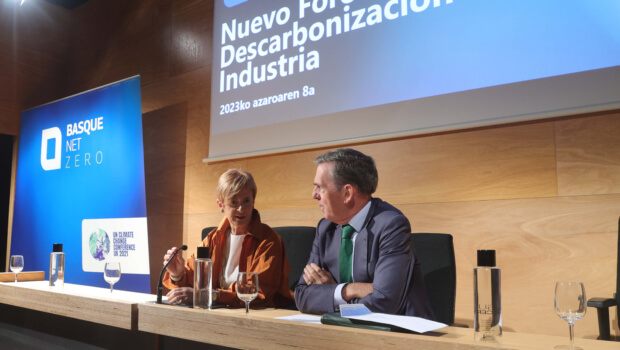
The Basque Government’s Minister of Industry, Energy Transition and Sustainability, Mikel Jauregi, reminded today that Basque industry pays the highest energy prices compared to other European countries it must compete with, such as France and Germany—“which creates a clear disadvantage and a real loss of competitiveness.” For this reason, he urged the Spanish Government to “implement an energy policy that supports industry, as other European countries do, to eliminate the distortions that hinder competitiveness. We need to simplify the bill and reduce costs,” he emphasized.
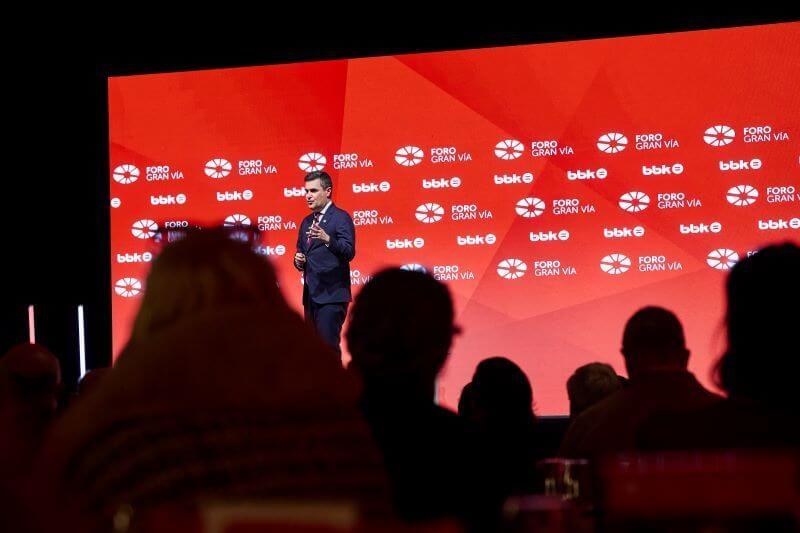
Jauregi made these remarks during a conference held this morning at the Gran Vía Forum, a plural dialogue platform promoted by the BBK Banking Foundation to reflect on major challenges in Bizkaia and Euskadi, gathering business leaders, institutional representatives, and political and social figures from the region.
“Our goal as the Basque Government is to ensure that the final electricity price paid by industry is as competitive as in the rest of Europe—without jeopardizing the energy transition or investments in the grid, which are essential for electrification and industrial decarbonization.”
Spain Generates the Cheapest Energy but Pays the Highest Bills
As the Minister recalled, the Iberian Peninsula generates some of the cheapest electricity in Europe thanks to abundant renewable resources—especially sun and wind—which allow for abundant, low-cost renewable generation, “even creating hours with zero or negative prices in the wholesale market.”
However, despite producing the cheapest energy, “the final price paid by our industry is much higher compared to other European countries, due to factors unrelated to generation costs, such as taxes, tariffs, or limited use of exemptions.”
“In fact,” he noted, “electricity costs for our industry can be 165% higher than in France and 35% higher than in Germany. Both countries manage to lower their final prices through regulatory measures that clearly favor energy-intensive industrial sectors.”
Jauregi emphasized that this gap in electricity prices between Spain and countries like France or Germany “clearly affects the competitiveness of our energy-intensive sectors—such as metallurgy, aluminum, chemicals, paper, glass, and automotive—where electricity bills can account for up to 50% of production costs. Any variation, therefore, has a serious impact on the competitiveness of our industry. We must change this reality.”
“To boost the competitiveness of our energy-intensive industry, the most effective lever we can activate in Spain is aligning final electricity costs with our main European competitors—France and Germany,” he stated.
Higher Prices Due to Surcharges Unrelated to Electricity Supply
The Minister clarified that Basque industry pays higher electricity bills than its European competitors “not due to energy costs themselves, but because of multiple surcharges unrelated to the electricity supply, which are not aligned with a future-focused, long-term industrial policy.”
He referred to regulated costs, fiscal charges—such as the 7% electricity generation tax—mandatory contributions to funds—such as the Energy Efficiency Fund—and system costs “which could be covered through the General State Budget.”
Along these lines, Jauregi pointed out that Spain “must fully leverage the tools provided by the European Union to protect its industry, as other countries like France and Germany do.”
Therefore, the Minister called on the Spanish Government to implement an energy policy aligned with that of countries competing with Spanish industry, to reduce this competitive disadvantage.
Proposed Measures to Align Prices with European Competitors
Specifically, the Basque Minister of Industry proposed the following measures to simplify the bill and reduce the final cost faced by industry in Spain. On the fiscal side, he proposed eliminating the 7% tax on electricity generation. “We request that this tax on the value of electricity be reduced to 0%.” Additionally, he proposed an 80% exemption on Transmission & Distribution (T&D) tariffs for energy-intensive consumers, to be included in the electricity tariff methodology that the CNMC must publish this year.
Lastly, he called for regulatory measures such as maximizing compensation for indirect CO₂ costs. Up to 25% of the revenues from greenhouse gas emission rights auctions could be used to offset the indirect cost impacts related to electricity consumption.
“With these perfectly legal measures—already in place in other European countries—the electricity bill for large consumers could be cut almost in half. We are actively listening to our industry in various Sectoral Working Groups and are acting accordingly,” he stressed.
The Basque Government Offers to Collaborate with the Spanish Government
Jauregi stressed that implementing these measures requires inter-ministerial coordination, with close collaboration between the Ministry of Finance and the Ministry of Ecological Transition and Demographic Challenge (MITECO), as well as the additional involvement of the Ministries of Industry and Economy. “We must all work together on this. That is our call to the Spanish Government.”
The top Industry official of Euskadi concluded his speech by reaffirming that the Basque Government “continues to support industry in its energy transition and efforts to increase competitiveness. We remain attentive to its needs and to the international context. We advocate for affordable, competitive energy under equal conditions. Achieving more industry, better industry, and lower emissions in Euskadi will only be possible if we guarantee a sound energy framework.”